Показаны сообщения с ярлыком go. Показать все сообщения

суббота, 3 сентября 2016 г.

Semi-irregular Sysadmin Ninja's Github Digest (Vol. 20)

Hello, fellow readers!
I'm back. Now back to the news! :)

parallel
Inspired by GNU Parallel, a command-line CPU load balancer written in Rust.
Same as GNU Parallel, but modern and fast.
https://github.com/mmstick/parallel

rclone
"rsync for cloud storage" - Google Drive, Amazon Drive, S3, Dropbox, Backblaze B2, One Drive, Swift, Hubic, Cloudfiles, Google Cloud Storage, Yandex Files http://rclone.org
https://github.com/ncw/rclone

NASA's openmct
A web based mission control framework. https://nasa.github.io/openmct/
You will need it if your project is rocket science ;)
awesome-osx-command-line
Use your OS X terminal shell to do awesome things. A curated list of shell commands and tools specific to OS X.
https://github.com/herrbischoff/awesome-osx-command-line

worq
Job server in Go
https://github.com/iamduo/workq
Similar to Celery / Gearman but language agnostic and written in Go.

go-patterns
A curated list of Go patterns and idioms http://tmrts.com/go-patterns
https://github.com/tmrts/go-patterns
Worth checking for all Go programmers.

minio
Minio is an object storage server compatible with Amazon S3 and licensed under Apache 2.0 License https://minio.io
https://github.com/minio/minio
Defying Amazon's vendor lock. Didn't try it, though.

Mozilla's http-ovservatory
HTTP Observatory https://observatory.mozilla.org/
https://github.com/mozilla/http-observatory
"The Mozilla HTTP Observatory is a set of tools to analyze your website and inform you if you are utilizing the many available methods to secure it."
Special bonus for machine learning lovers!

spez
Image super-resolution through deep learning
https://github.com/david-gpu/srez
"From left to right, the first column is the 16x16 input image, the second one is what you would get from a standard bicubic interpolation, the third is the output generated by the neural net, and on the right is the ground truth."
Looks like magic -


PADDLE
PArallel Distributed Deep LEarning http://www.paddlepaddle.org/
https://github.com/baidu/Paddle
"PaddlePaddle (PArallel Distributed Deep LEarning) is an easy-to-use, efficient, flexible and scalable deep learning platform, which is originally developed by Baidu scientists and engineers for the purpose of applying deep learning to many products at Baidu."


воскресенье, 7 декабря 2014 г.

Graphite scaling and my evaluation of Zipper Graphite stack

Hello!
Many Dev/Ops teams out there are using Graphite – nice tool for collecting and graphing various metrics from your software and/or hardware. It is a really nice tool and a good example of good architecture – you can check out Graphite chapter from famous AOSA book.
But it's also not a big secret that despite Graphite is great tool its scaling is really not an easy task. Until you run it on single server – everything is fine, you can easily spread it over a couple of servers but above that…
·      Problem one. If you are using (default and single production ready) whisper storage, then the single option of clustering is to use normal Graphite cluster mechanism. But then, after adding or removing some nodes from cluster you need to rebalance it, using e.g. carbonate tool. It’s fine but for loaded cluster with hundreds of thousands metrics and tenths servers, it could take not hours - but days and weeks - and during rebalancing Graphite cluster will producing very funny results.
·      Problem two. Current Graphite clustering based on HTTP requests (remote nodes asks each other using same Graphite-web engine) and current code is quite non-optimal, especially for aggregating functions across many nodes. Fixing that is in progress, we already have @bmhatfield's patch in 0.9.x branch (also with not merged yet parallelization improvement), another approach from @jraby which was transformed to patched graphite-web from @datacratic.
·      The third problem is relay / aggregator performance problems. Graphite relays and aggregators are CPU-bound (contrary to carbon-caches, which are IO-bound) and because of python's GIL single process can't use more that one core for CPU-intensive calculations. Then you need to create some loadbalancer-based configurations with many relay processes, which doesn't make things less complex, believe me.

So, if you faced with Graphite scaling problems you have next options:

1. Migrate to OpenTSDB.
Unfortunately, it will require quite big efforts, if you have your Graphite installation up and running for a while, and have many tools and dashboards around it. Also, scaling Hbase is a the little bit harder than throwing more servers into the pool...

2. Migrate to new storage engines.
I'll explain this way little bit.  Which alternative options do we have for now?
a)    @pyr's cyanite
Quite mature, has some production instances running. Uses Cassandra as storage looks like the natural choice for Graphite data because of high write-load tolerance.
I made an evaluation of it and found out that for our metrics it'll require 4x more space for data storage. For us it was "no-go" then, also I was suspecting that its scalability was not so great then (it was year ago, now it's much better)
InfluxDB looks also like quite a natural choice for storage - it's native time series database, with built-in sharding and clustering. Dieter Plaetinck wrote this for Vimeo and run it there in production.
In my tests InfluxDB look much better as storage - it took almost exact same space as whisper, but - only for one month. It's because of InfluxDB still has no retentions with aggregations (current InfluxDB's retentions just purge old data without any aggregation) - so, if you need to make queries across big timespan (e.g. year) you need or store all data with high precision (and wasting space) or make some aggregation by own - but of course, it will hit performance quite bad. Theoretically, you can use continuous queries for aggregation on InfluxDB level, but its support not integrated to graphite-influxdb.
And according to @dieterbe he's running graphite-influx on a single node, for now, so, I also suspect that scaling it across many nodes could be quite an adventurous journey too.
c)    ceres. Looks like abandoned for now.  I know that @dkulikovskiy made some changes in his own repo, including new roll-up mechanism – and Yandex running that on quite a big scale - but anyway, it doesn't look like a right path to go.

So, we still stick up with whisper, so, no solution for problem one yet for us, but if you only start running your Graphite – maybe it’s a good idea to run some new storage in parallel – especially if you already have some Cassandra or InfluxDB in production.
What next? What is about other problems?

We also faced relay scaling problems quite fast, and after struggling with that little bit we adopted Scala-based @markchadwick's graphite-relay – I just make it work correctly with graphite hashing. We lived about a year on that but after it starts to consume too much CPU too.
In that time, my boss @vlazarenko point me on this video from Linux.conf.au 2014 – it’s only 20 minutes and worth watching. I found out from it that Booking.com uses Graphite, and uses it under quite a big load. In this video, Devdas Bhagat also mentioned that after struggling with relay scalability they developed (and what is much better – open-sourced) new and shiny C-based graphite relay, named carbon-c-relay. (Edit: first I mistakenly named it  graphite-c-relay, d-oh... real name is and always was carbon-c-relay). We started using it instantly and from that time and up to now it works very well.
Its main contributor, Fabian Groffen, also implemented aggregation and regexes in a couple of last months, so, for now, carbon-c-relay looks like complete and pretty sane alternative for python-based relay/aggregation daemons. I can find only one downside – its output is still line-based and not-pickle based but that’s completely OK for us. Edit: As @grobian mentioned (and I completely agreed with that) pickle is insecure and bloated - line protocol is better for that case.

So, third problem is solved for now.
But I was really wandered how Booking.com struggling with second scaling problem, and after following @grobian on GitHub I found out how. It seems that they rewrite most of the parts of Graphite stack in Go! And results of it's quite impressive – they’re running about 90 backend servers with more than 55TB of whisper files!
And it looks like this project implemented by only two persons - Damian “@dgryski” Gryski and @grobian. I contacted Damian, asked a couple of questions and checked how their solution works. He also said that he and @grobian will make a blog post about their stack, but they still didn't - so, I'll try to do so. J

So, how normal Graphite cluster stack looks like? I'll take part of Jamie picture to illustrate:

Did you see that 3 graphite-web servers below? They’re communicating between each over (or a single frontend to all backends), so just imagine what happens if you have 10-20-30... backend servers instead of two - and you can imagine that speed of rendering will be very low then.
Then check out Booking.com solution (they need some cool name for it, I will call it zipper-stack for brevity). Please also bear with my non-existing painting skills:


See? Graphite-web talking to the single daemon, named carbonzipper. It talks to all backends, but not over plain text based “pickle-over-HTTP” protocol, but over new “protobuf-over-HTTP” protocol - so, on backends we have a separate daemon for speaking that, named carbonserver. Also, they have special carbonapi daemon - it talks to zipper daemon also but it has some subset of Graphite functions re-implemented in Go, so, his speed is blazing fast - you can switch all your monitoring metrics (which rendering as text and not PNG) there. 
So, looks good - let's deploy it.
As we are doing only evaluation we made it quick-and-dirty – just compile binaries and run it on a server, but for production you’ll need some packaging and configuration, of course. Also, it’s not a manual for Graphite installation – I assume that you have working Graphite cluster already and just want to check how-zipper stack works.
Initial build is easy - go to your build VM, install and set up Go there and run
root@vagrant-ubuntu-precise-64:~# go build github.com/dgryski/carbonapi
root@vagrant-ubuntu-precise-64:~# go build github.com/dgryski/carbonzipper
root@vagrant-ubuntu-precise-64:~# go build github.com/grobian/carbonserver
root@vagrant-ubuntu-precise-64:~# ls -al ~/go/bin/carbon*
total 53552
drwxr-xr-x 2 root root    4096 Nov 28 16:32 .
drwxr-xr-x 5 root root    4096 Aug  8 13:20 ..
-rwxr-xr-x 1 root root 8796848 Oct 28 16:38 carbonapi
-rwxr-xr-x 1 root root 8526040 Oct 28 16:36 carbonserver
-rwxr-xr-x 1 root root 8515904 Oct 28 16:37 carbonzipper

Copy caronserver binary to graphite backends, and carbonzipper and carbonapi binaries to your frontend. If you do not have separate frontend - just make it - install separate server with graphite-web and install binaries there)

Go to backends first and run servers there - do not forget run it under same user as carbon-caches (e.g. using screen when testing):
~$ ./carbonserver -p=8080 -stdout=true -v=true -vv=true -w="/opt/graphite/storage/whisper"
2014/12/07 16:13:10 starting carbonserver (development build)
2014/12/07 16:13:10 reading whisper files from: /opt/graphite/storage/whisper
2014/12/07 16:13:10 set GOMAXPROCS=12
2014/12/07 16:13:10 listening on :8080

Next, run carbonzipper on the frontend. Create its config file first:
~$ cat zipper.json
 {
    "Backends": [
        "http://10.x.y.z1:8080",
        "http://10.x.y.z2:8080",
        
"http://10.x.y.z3:8080"
    ]
}
I think you got the pattern. J
Then run it in debug mode:
~$ ./carbonzipper -c="./zipper.json" -p=8080 -stdout -d=3
2014/12/07 15:58:44 starting carbonzipper (development version)
2014/12/07 15:58:44 setting GOMAXPROCS= 1
2014/12/07 15:58:44 querying servers= [http://10.x.y.z1:8080 http://10.x.y.z2:8080 http://10.x.y.z3:8080] uri= /metrics/find/?format=protobuf&query=%2A
2014/12/07 15:58:44 listening on :8080

Now you need to patch graphite-web little bit - after putting own IP to CLUSTER_SERVERS is not allowed - and that's exactly what we need to do:

--- a/webapp/graphite/storage.py
+++ b/webapp/graphite/storage.py
@@ -31,7 +31,7 @@
def __init__(self, directories=[], remote_hosts=[]):
self.directories = directories
self.remote_hosts = remote_hosts
- self.remote_stores = [ RemoteStore(host) for host in remote_hosts if not is_local_interface(host) ]
+ self.remote_stores = [ RemoteStore(host) for host in remote_hosts ]

if not (directories or remote_hosts):
raise valueError("directories and remote_hosts cannot both be empty")


Then run your frontend with CLUSTER_SERVERS = ['127.0.0.1:8080'] in local_settings.py.

Everything is prepared; you can test your frontend with normal graphs.
You can check how carbonapi works too, but you need to check which functions were re-implemented in Go in https://github.com/dgryski/carbonapi/blob/master/expr.go first:

~$ ./carbonapi -z="http://localhost:8080" -stdout=true -p=9090 -tz="Europe/Amsterdam,3600"
2014/12/07 16:01:27 starting carbonapi (development build)
2014/12/07 16:01:27 using zipper http://localhost:8080
2014/12/07 16:01:27 using fixed timezone Europe/Amsterdam, offset 3600
2014/12/07 16:01:27 listening on port 9090

That's mostly it.
But I want to mention just one important thing. When I test my graphs with zipper-stack with curl rendering speed was quite good. But when I test my last hour graph generated by zipper-stack instance by my eyes it was looking like this:


Normal one looks like that:

Huh? Do you know what's happened there? I know, unfortunately.
As I mentioned, Graphite is a really good piece of software and use quite good engineering solutions to make thing works with quite a big load on pure Python, not even using C. And most known part of this trick is named carbon-cache. E.g. when you put metrics in graphite usually it doesn't flush to disk instantly but goes to RAM instead using carbon-cache daemon, which keeps it in memory, flushes to disk periodically, and responses results to Graphite web, merging on-disk and in-memory results. 
As you can see on my diagram there're no more lines from carbon zipper to carbon-caches for zipper stack. That's right - carbonserver just reads whisper files from disk and didn't ask carbon-caches! It seems that for booking.com instances disk flushing time for every single metric is below 60 seconds, and for “1-minute retention” whisper files (which they and we are using) after each minute every file is updated and fresh. But our Graphite installation is different - we are using SAN disks and plenty of RAM instead of SSDs, so, for us it took up to 40 minutes to flush metric to disk, that’s why we have that graph depletion on “1-hour” graphs…
So, for us, it's not looks like a viable solution, alas! Or we need to implement carbon-cache interface to carbonserver in Go. But in a moment when I test zipper-stack, we were running an internal version of the hack, which shortly become PR #1010 and it works quite well, for now, so, maybe I return to it later. J
Edit: @grobian is making Go-based write daemon now - https://github.com/grobian/carbonwriter - so, maybe it could be combined with carbonserver to make similar to carbon-cache solution.
But YMMV, of course, just try zipper-stack - it looks very good and promising. 


суббота, 27 сентября 2014 г.

Semi-irregular SysadminNinja's Github Digest (vol. 13)

Hi All,

Third part of digest, most current one!
Two more to come.

1. gogs
Gogs(Go Git Service) is a painless self-hosted Git Service written in Go.
http://gogs.io
https://github.com/gogits/gogs

Another Github clone, but written in Go. Worth checking, if you need one.

2. pyston
An open-source Python implementation using JIT techniques.
https://tech.dropbox.com/2014/04/introducing-pyston-an-upcoming-jit-based-python-implementation/
https://github.com/dropbox/pyston

New Python implementation, blazingly fast, looks promising, recommended by Guido himself :).

3. profiling
An interactive Python profiler.
https://github.com/what-studio/profiling
Nice looking Python profiler, still under development but looks good:

4. blackbox
Safely store secrets in Git/Mercurial http://the-cloud-book.com
https://github.com/StackExchange/blackbox

Another solution for storing secrets in your repos, but now from StackExchange and @yesthattom himself. Fresh and professional looking.

5. sfr1-lite
Search Formula-1 - A distributed high performance massive data engine for enterprise/vertical search
https://github.com/izenecloud/sf1r-lite
Vertical search engines are quite rare in open-source landscape. It's a new one from some Chinese startup, check tech docs in English for details.

6. mannaggia
automatic saint calling for depressed Veteran unix Admins, in italian
https://github.com/LegolasTheElf/mannaggia
Hah, funny thing. "Automatic saint calling for depressed Veteran unix Admins, in italian
Developed in italian, can be easily adapted in other languages."
TIL what "mannaggia" means. :)

7. shellshoc_poc
Shellshock DHCP RCE Proof of Concept
https://github.com/mschwager/shellshock_poc
Proof of concept of shellshock attack on DHCP server. See https://www.trustedsec.com/september-2014/shellshock-dhcp-rce-proof-concept/ for details:

8. bash_shellshock 
Wrapper for /bin/bash that mitigates 'shellshock' 
If you do not trust current Shellshock fixes you can use own wrapper to secure your server(s).


суббота, 16 августа 2014 г.

Semi-irregular Intresting Github Repos Ops Digest #10 (August 15)

Hi All,

New name for that digest come into my mind - Semi-irregular! It sounds good for me, let's stick with that.
I want to make some celebration with Issue #10, but first I found out that no really cool projects to show for a week - maybe because of summer/vacation time, I don't know. So, I was waiting for one more week, and now -

Semi-irregular Intresting Github repos (for) Ops Digest, issue 10:

First, fresh docker projects:

1. docker-cheat-sheet
Docker Cheat Sheet
https://github.com/wsargent/docker-cheat-sheet

Good cheat sheet for Docker, must read.

2. flocker
Easily manage Docker containers and their data https://clusterhq.com
https://github.com/ClusterHQ/flocker

Open-source Docker orcestration service. Also, not much to say, please try tutorial.

3. flynn
A next generation open source platform as a service (PaaS) https://flynn.io
https://github.com/flynn/flynn

Ah, that's more complicated thing, but looks very promising - latyered open-sourced PaaS platform, check it out.

4. github-trending
Tracking the most popular Github repos, updated daily
https://github.com/josephyzhou/github-trending

Self explanatory, tracking the most popular Github repos and updating list of top objective-c, javasript and go repos in markdown output daily. You can pick other languages and run own tracker if you want.

5. cloud-ssh
Cloud enhanced SSH client replacement with host auto-completion
http://leonsbox.com/cloud-ssh/
https://github.com/buger/cloud-ssh

Cloud enhanced SSH client replacement with host auto-completion, espicially nice for AWS hosts.

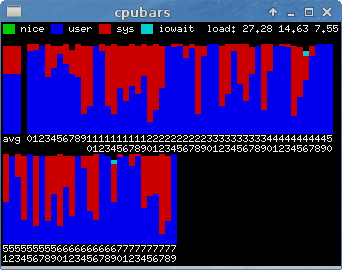
6. cpubars
Lightweight terminal-based multicore CPU usage monitor
https://github.com/aclements/cpubars

cpubars is a simple terminal-based tool for monitoring CPU load in real-time, especially tailored to monitoring large multicores over SSH.


7. Password-Repo
https://github.com/Tek-Security-Group/Password-Repo

Quite good collection of password lists, which help to your services be more secure, I mean if you will deny using that obvious passwords for users.

8. mooltipass
Github repository dedicated to the mooltipass project
https://github.com/limpkin/mooltipass

Very nice project, indeed, like it very much! Aruino-based hardware password storage, powered by smartcard - wow! Fully open-sourced. Prototype is looking like that:


Ceators selling it for 80$, but real paranoid needs to built this by own, of course.
More and more sysadmin tools starts to be written in Go language. This is collection of Go stuff for ops engineers, check it out
And useful port of psutil library for Go:
10. gopsutil
psutil for golanghttps://github.com/shirou/gopsutil

Also some vim plugins was detected by by Github radar this week:

11. vim-plug
Minimalist Vim Plugin Manager https://github.com/junegunn/vim-plug

New Vim plugin manager, like it:


12. vim-grammarous
A powerful grammar checker for Vim using LanguageTool.
https://github.com/rhysd/vim-grammarous

"vim-grammarous is a powerful grammar checker for Vim. Simply do :GrammarousCheck to see the powerful checking"

13. vim-go
Go development plugin for Vim https://github.com/fatih/vim-go

"Full featured Go (golang) support for Vim. It comes with pre-defined sensible settings (like auto gofmt on save), has autocomplete, snippet support, improved syntax highlighting, go toolchain commands, etc... It's highly customizable and has settings for disabling/enabling features easily."Nuff said.

Fun section:
14. carp
"interesting" VM in C. Let's see how this goes. 
https://github.com/tekknolagi/carp
Sample realization ov virtual machine in C. Check if you want to how to find how VM works.

15. sunfish
Sunfish: a Python Chess Engine in 111 lines of code
https://chessprogramming.wikispaces.com/Sunfish
https://github.com/thomasahle/sunfish


"Sunfish is a simple, but strong chess engine, written in Python, mostly for teaching purposes. Without tables and its simple interface, it takes up just 111 lines of code!
The clarity of the Sunfish code provides a great platform for experimenting, be it with evaluation functions, search extensions or anything. Fork it today and see what you can do!"

16. anagramatron
twitter anagram hunter http://anagramatron.tumblr.com/
https://github.com/cmyr/anagramatron

"Anagramatron hunts for pairs of tweets that use the exact same set of letters.
This script connects to the twitter stream. When it receives a new tweet it runs it through some filters, ignoring tweets that contain things like links or @mentions, or that contain less then a minimum number of characters."
You can check results of it on http://anagramatron.tumblr.com/

Small disclaimer: I'm just big fan of Github and since we have so many sources of information around I pick Github as source of information for my digest of interesting open-source projects. And because I'm Ops/Sysadmin person - I choose projects which somewhat ops-related, but not necessary. I'm not GitHub employee and this digest is not connected with GitHub in any way.

вторник, 29 июля 2014 г.

Weekly Ops Github Digest #8 (July 29th 2014)

So, it seems that our digest becoming quite regular, it's issue number 8 and number 7 was out exactly one week ago, same as issue 6 was two weeks ago, nice.

Let's try to keep it that way - new issue every Monday/Tuesday, for fresh start of new week!
... but please note that possible upcoming vacation can interfere with my intentions. :)

OK, let's go.

1. elvish
An experimental Unix shell
https://github.com/xiaq/elvish

Nice new experimental shell (written in Go), more traditional than Xiki but also with intresting new features, like nice autocompletion and navigation mode, built in daemon for syncing command history from different instances and new Clojure/Lisp-like built-in language. Worth a try, but only if you have Linux, it doesn't compile on Mac, so, if you have one and want to be a contributor - welcome.

2. perf-tools
Performance analysis tools based on Linux perf_events (aka perf) and ftrace.
https://github.com/brendangregg/perf-tools

Set of performance analyzing tools for Linux, using (relatively) new Ftrace interface, written by famous Brendan D. Gregg, author of Systems Performance book, DTrace book etc.

Will not talk much about that, in short - amazing stuff, check my previous post about it.

3. Next 3 repos connected with Docker, lets merge them together:

Fig.
Fast, isolated development environments using Docker http://www.fig.sh
https://github.com/orchardup/fig

Describe your environment in single file and run it with single command "fig up".
Looks cool? Then check out

Octohost.
Simple web focused Dockerfile based PaaS server.
http://www.octohost.io/
https://github.com/octohost/octohost

Similar idea, but realization is little bit different - and idea is more general and limited at the same time. Just add Dockerfile to your webapp and after that run "git push" to deploy your project on choosen environment (Vagrant/Amazon/Digital Ocean/Rackspace/own server) - but only limited (but quite poular) languages and platforms are supported.

Next thing -
Registrator.
Service registry bridge for Docker
https://github.com/progrium/registrator

will help you with automatic "register/deregisters services for containers based on published ports and metadata from the container environment". I.e. you can automatically add/remove services to LB, for example. External service registers/pairing/discovery are supported also. Nice thing if your building scalable application on Docker.


Going to more general developer's stuff.

4. Two Git help pages. More general

Git Cheat Sheet
https://github.com/ArslanBilal/Git-Cheat-Sheet


and more specific

git-flight-rules
https://github.com/k88hudson/git-flight-rules


First one is normal Git cheat sheet, but second one is more like FAQ and list of common tasks and workarounds.


5. CockroachDB.
A Scalable, Geo-Replicated, Transactional Datastore
https://github.com/cockroachdb/cockroach


So, it looks like NoSQL is not very popular buzzword now, NewSQL is much better!
But if talking seriously it really looks promising - it took better parts from both worlds:


ALPHA for now, we'll see how it'll going.

6. pycrastinate
TODO less, DO more. Keep your code clean without changing the way you code.
https://github.com/isaacbernat/pycrastinate

Pycrastinate is a language-agnostic tool that helps you keep your codebase (whether it is legacy or new) under control in a transparent way (i.e. without interfering with your coding). I.e. it checks for FIXMEs and TODOs and gently tring to force you to do something with that. :)
Check this talk or slides if interested.

7. Streisand.
https://github.com/jlund/streisand

"Streisand sets up a new server running L2TP/IPsec, OpenSSH, OpenVPN, Shadowsocks, Stunnel, and a Tor bridge. It also generates custom configuration instructions for all of these services. At the end of the run you are given an HTML file with instructions that can be shared with friends, family members, and fellow activists."
Not like very funny thing, especially for persons who struggle with internet censorshop somewhere but worth to checking then.

And time for fun!

8. IPFS
The Permanent Web http://ipfs.io
https://github.com/jbenet/ipfs

According to website:
"IPFS is a global, versioned, peer-to-peer filesystem. It combines good ideas from Git, BitTorrent, Kademlia, SFS, and the Web. It is like a single bittorrent swarm, exchanging git objects. IPFS provides an interface as simple as the HTTP web, but with permanence built in. You can also mount the world at /ipfs."
Very experimental thing for now, but maybe it's the source of new Internet, who knows?

вторник, 1 июля 2014 г.

Sporadic Ops GitHub digest #2 (01 Jul 2014)

Second issue of mine Sporadic Ops GitHub digest.

1. A curated list of awesome Python frameworks, libraries and resources. 
Inspired by awesome-php
https://github.com/vinta/awesome-python

Tons of useful stuff for pythonistas.

2. A well-written BSD licensed C language TLS implementation
https://github.com/wbl/SolidTLS

Another fork/rewrite of OpenSSL 'bloatware', good to know.

3. Simplistic interactive filtering tool
https://github.com/peco/peco

Cool little console tool, check screencasts for details.

4. Wrk - Modern HTTP benchmarking tool
https://github.com/wg/wrk

Lua-powered multi- thread / core HTTP benchmarking tool.

понедельник, 30 июня 2014 г.

Sporadic Ops GitHub digest #1 (30 Jun 2014)

For no specific reason I decided to put some interesting for Ops engineer (on my opinion) Github projects to periodical (I hope) but quite sporadic digest.

So, what we have for today, in no particular order:

1. UNIX command line client for Twitter written in Go 
Just toy for now, please contribute.

2. Terminal-based SoundCloud client. 
Without all these stupid CSS files. Runs on OSX and Linux https://github.com/grobie/soundcloud2000

3. An open-source graph database by Google 
https://github.com/google/cayley
Good competitor for Neo4J (maybe, someday, in future).

4. Securely and anonymously share a file of any size 
Tricky mix of Tor and python, I like that!

5. A drop-in, low-overhead monitoring web dashboard for a linux machine https://github.com/afaqurk/linux-dash 
Simple PHP-based dashboard for one server.

6. Ajenti - the web admin panel everyone wants. http://ajenti.org
https://github.com/Eugeny/ajenti 
Neat web admin panel, looks cool and modern!

7. Offline version of Project Euler 
8. A Python framework for creating interactive Twitter bots